Repeated ankle sprains can stretch or tear the lateral ligaments even when no fracture appears on an X-ray. By the end, you will know how clinicians distinguish mechanical instability from other causes of ankle pain, when rehabilitation has been given enough time, and when repair or tendon-graft reconstruction is a reasonable option.
Key takeaways
- Repeated sprains can damage ankle ligaments without causing a fracture.
- Complete structured rehabilitation before considering surgery for persistent instability.
- Direct repair suits repairable ligaments; tendon grafts replace poor-quality tissue.
- Ask about rehabilitation milestones, sports timelines, and the surgeon’s complication rates.
Do repeated ankle sprains cause chronic ankle instability without a fracture?
Repeated ankle sprains can cause chronic ankle instability even when no fracture appears. Each rolling episode can stretch or damage the anterior talofibular ligament and calcaneofibular ligament. Warning signs include recurrent giving way, swelling after activity, tenderness over the lateral ligaments, and an ankle that feels unreliable on uneven ground.
| Type of instability | What it means | Typical clues |
|---|---|---|
| Mechanical instability | The ligaments no longer restrain ankle movement adequately | Excessive talar movement on anterior drawer testing or excessive tilt on talar tilt testing |
| Functional instability | The ankle feels unstable because balance, proprioception, strength, or coordination have not recovered | Recurrent giving way despite little measurable laxity, especially during sport or on uneven ground |
Do not assume the ligaments are the only problem. Peroneal-tendon injury, a syndesmotic or “high ankle” injury, cartilage or osteochondral damage, impingement, cavovarus alignment, and arthritis can all cause pain or repeated failure after a sprain.
Clinicians combine your injury history with examination rather than relying on one scan. Weight-bearing X-rays show fracture, alignment, arthritis, or some cartilage-related bone lesions; stress radiographs can document laxity; ultrasound can assess dynamic ligament and peroneal-tendon problems; MRI evaluates ligament quality, cartilage, tendons, and syndesmotic injury. A normal MRI does not rule out functional instability.
Ankle instability treatment therefore starts with the documented cause, often using bracing, activity changes, balance exercises, strengthening, and physiotherapy before reconstruction is considered.
How long should ankle instability treatment continue before surgery?
Give ankle instability treatment a structured trial for roughly 3–6 months before deciding on surgery. Repeated sprains alone do not prove that a ligament reconstruction is necessary; the ankle may need better strength, balance, footwear support, or movement control rather than an operation.
An adequate programme includes:
- Reduce running, jumping, uneven-ground walking, and other activities that trigger giving way. Keep pain-free movement and gradually reload the ankle.
- Use an ankle brace or taping during sport and risky activities. Choose stable shoes with a firm heel counter and good grip; worn-out or flexible footwear can undermine recovery.
- Complete balance and proprioception exercises, progressing from single-leg standing to unstable-surface work, hopping, landing, and direction changes.
- Strengthen the calf and peroneal muscles with resisted eversion, heel raises, controlled lowering, and sport-specific drills.
- Attend supervised physiotherapy so a clinician can correct technique, measure strength and balance, and progress activity safely.
Persistent giving way, lateral ankle pain, or swelling after this programme supports a surgical discussion. The potential ankle ligament repair benefits include improved stability and fewer recurrent rolls, but surgery will not correct untreated tendon, cartilage, impingement, alignment, or neuromuscular problems.
Seek earlier specialist assessment after a major ligament defect, gross mechanical instability, or when high-level sport demands reliable cutting and landing. A clinician should document the instability pattern and associated injuries before recommending repair or tendon-graft reconstruction.
When is direct ligament repair better than tendon-graft reconstruction?
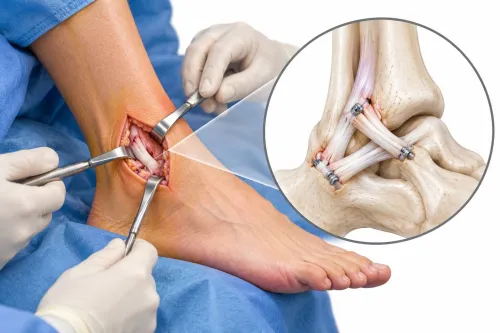
Direct repair is better when the anterior talofibular ligament, and when necessary the calcaneofibular ligament, still has enough healthy tissue to hold sutures. A modified Broström-type anatomic repair restores the native ligament position without adding a tendon graft.
| Option | What it involves | When it applies |
|---|---|---|
| Direct anatomic repair | Suturing and anchoring the native anterior talofibular ligament, with calcaneofibular repair when required | Good-quality tissue, clear mechanical instability, and no major generalized laxity |
| Autograft reconstruction | Rebuilding the ligament with your own tendon | The native ligament is stretched, attenuated, scarred, or unsuitable, especially in generalized laxity or revision surgery |
| Allograft reconstruction | Rebuilding the ligament with donor tendon | Revision cases or poor native tissue when an autograft is undesirable or unavailable |
Repeated sprains alone do not establish a need for reconstruction. The decision depends on documented mechanical or functional instability, failed structured rehabilitation, tissue quality, alignment, and associated injuries.
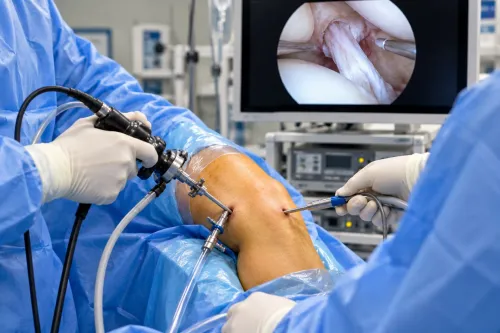
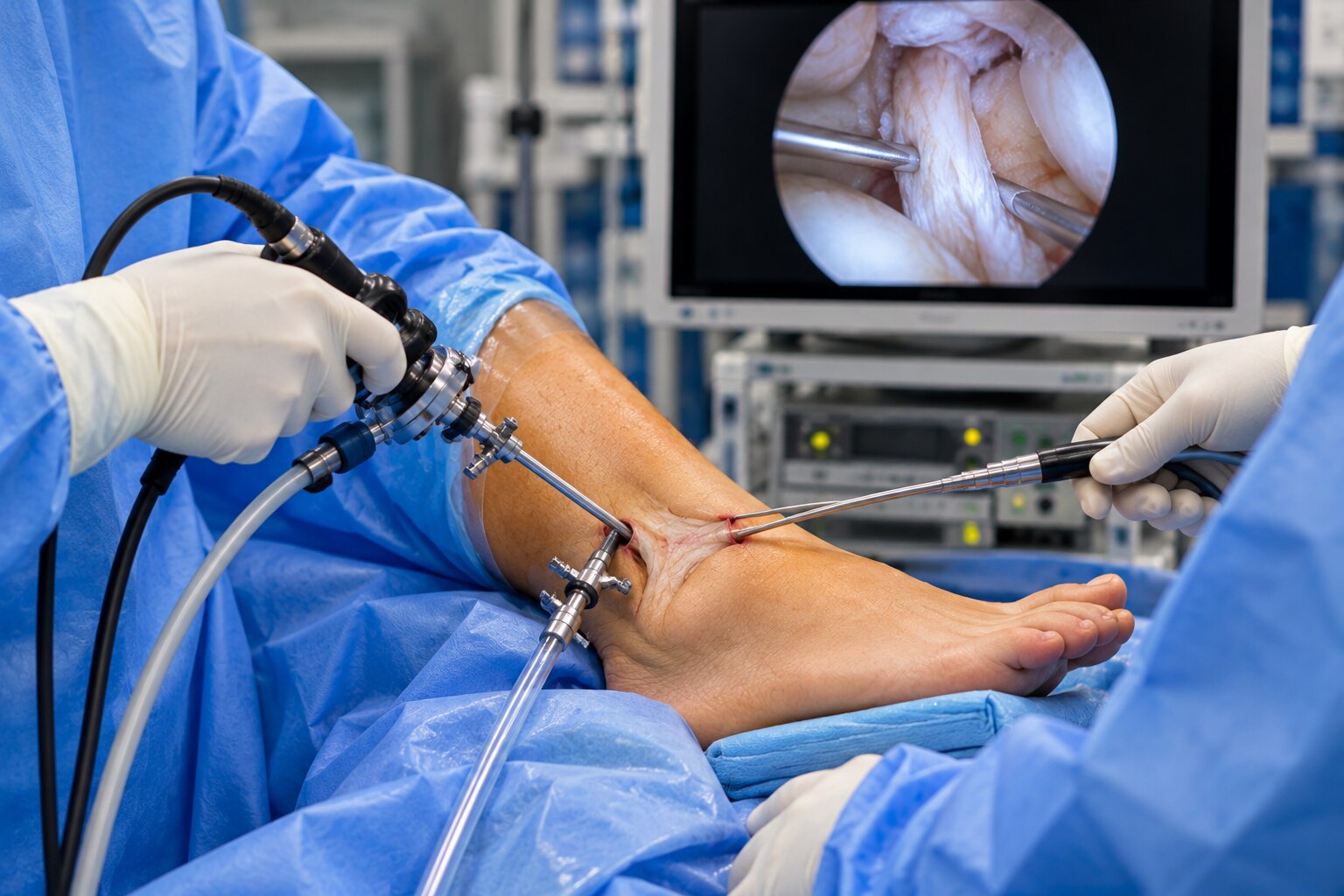
Surgery may address an isolated ligament problem, but persistent pain can instead require treatment for a cartilage or osteochondral lesion, loose body, synovitis, impingement, peroneal-tendon disease, high ankle sprain, cavovarus malalignment, or arthritis. Arthroscopy can inspect or treat these joint problems; it is not an automatic substitute for ligament stabilisation.
For ankle ligament reconstruction for repeated sprains in Mumbai or ankle ligament surgery in Mumbai, ask which ligament is unstable, whether direct repair is feasible, and which associated lesions require treatment. The operative approach may be open, arthroscopic, or through small incisions.
Can ankle ligament surgery restore sports performance as well as stability?
Fewer giving-way episodes and better function are the main ankle ligament repair benefits. Repair or reconstruction restores mechanical stability, but it cannot guarantee a pain-free ankle or a return to pre-injury performance; cartilage damage, impingement, tendon disease, nerve irritation, stiffness, or arthritis may continue to limit sport.
Recovery after ankle surgery for athletes progresses by function, not the calendar:
- Protect the repair with prescribed immobilisation, restricted weight-bearing, and swelling control.
- Restore ankle range of motion without forcing the healing ligaments.
- Rebuild calf and peroneal strength, then test single-leg control.
- Progress from balance work to hopping, landing, acceleration, and deceleration.
- Add sport-specific running and cutting drills before unrestricted practice.
The surgery date and absence of pain are not return-to-play tests. Your clinician should assess strength symmetry, range of motion, balance, hopping and landing quality, running speed, and cutting control, then provide medical clearance. Returning early can expose a healing repair to another sprain.
Swelling, stiffness, weakness, altered sensation near the incision, and reduced confidence on uneven ground are common short-term obstacles. Contact the surgical team for worsening wound problems or unexplained calf symptoms. Less common complications include infection, nerve injury, blood clots, recurrent instability, over-tightening, and complex regional pain syndrome.
A structured rehabilitation plan remains essential even when the ankle feels comfortable.
What should you ask before choosing ankle ligament surgery in Mumbai?
Repeated sprains do not prove that reconstruction is necessary. Before discussing ankle ligament surgery in Mumbai, ask for a documented diagnosis based on your history, examination, weight-bearing radiographs, stress testing, ultrasound, or MRI. Imaging should support the examination, not replace it.
- Which ligament is unstable: the anterior talofibular ligament, calcaneofibular ligament, syndesmosis, or more than one?
- Is the instability mechanical, functional, or both?
- Has structured physiotherapy failed after bracing, balance training, and calf and peroneal strengthening?
- Do I have cavovarus alignment, generalized laxity, obesity, or a neuromuscular control deficit that needs treatment?
- Can the native ligament be repaired, or is a tendon graft needed?
- Which cartilage, tendon, syndesmotic, or impingement lesions will you treat?
- What objective tests will determine return to sport, and what is the staged rehabilitation plan?
| Option | What it means | When it applies |
|---|---|---|
| Native ligament repair | Re-anchors usable ligament tissue | Adequate tissue quality and a repairable tear |
| Tendon-graft reconstruction | Replaces insufficient ligament with graft tissue | Attenuated tissue, generalized laxity, or revision surgery |
| Arthroscopy with stabilisation | Inspects or treats joint pathology alongside stabilisation | Cartilage, loose-body, synovial, or impingement findings |
For ankle ligament reconstruction for repeated sprains in Mumbai, focus on documented findings and follow-up access rather than the city label or “minimally invasive” wording. An orthopaedic specialist such as Dr. Sujit Korday- Orthopaedic Surgeon should explain why the selected technique fits your anatomy, including the rehabilitation milestones required for ankle surgery for athletes.
Related service
Ankle ligaments reconstruction or repair Ankle ligaments reconstruction or repair Ankle ligament reconstruction or repair is a surgical procedure performed if the joint still feels unstable after a fracture. View service → |
Frequently asked questions
Do repeated ankle sprains cause chronic ankle instability without a fracture?
Yes. Repeated sprains can stretch or tear the anterior talofibular and calcaneofibular ligaments, causing recurrent giving way, swelling, tenderness, and poor confidence on uneven ground even when X-rays show no fracture.
How long should ankle instability treatment continue before surgery?
Try structured non-surgical treatment first, including activity modification, ankle bracing, balance training, strengthening, and physiotherapy. Surgery becomes a consideration when instability persists despite compliant rehabilitation and examination or imaging confirms ligament damage.
When is direct ligament repair better than tendon-graft reconstruction?
Direct repair is preferred when the native ligament has enough quality and can be reattached securely. A tendon-graft reconstruction is more suitable when the ligament is severely damaged, stretched, or unsuitable for repair.
Can ankle ligament surgery restore sports performance as well as stability?
It can restore mechanical stability and support a return to sport, but performance also depends on strength, balance, ankle mobility, sport-specific drills, and completing rehabilitation before returning to competition.
What should you ask before choosing ankle ligament surgery in Mumbai?
Ask which ligaments are damaged, whether repair or reconstruction is recommended, what imaging supports the diagnosis, how long rehabilitation takes, when driving and sport can resume, and which complications require urgent review.
Keywords