An ankle that repeatedly gives way can have stretched or torn ligaments, but persistent pain after a sprain does not automatically mean you need surgery. By the end, you will understand which ligaments are involved, how instability is confirmed, when repair differs from reconstruction, and what the operation and rehabilitation involve in Mumbai.
Key takeaways
- ATFL and CFL injuries commonly cause outer-ankle instability.
- MRI and physical tests help confirm chronic instability before surgery.
- Repair suits usable ligaments; reconstruction replaces damaged tissue with a graft.
- Compare surgeon expertise, rehabilitation plans, costs, and complication risks.
Which ankle ligaments cause instability, and what symptoms matter?
Lateral ankle instability usually involves the anterior talofibular ligament (ATFL), which is injured most often, and the calcaneofibular ligament (CFL); the posterior talofibular ligament (PTFL) is less commonly involved. These outer-ligament injuries differ from syndesmotic injuries (“high ankle sprains”) between the tibia and fibula, and medial injuries affecting the deltoid ligament.
| Injury pattern | Main location | Typical clue |
|---|---|---|
| Lateral instability | ATFL, CFL, sometimes PTFL | Giving way after routine or sports-related sprains |
| Syndesmotic injury | Ligaments between tibia and fibula | Pain higher above the ankle, especially with twisting |
| Medial ligament injury | Deltoid ligament on the inner ankle | Inner-ankle tenderness and instability |
Repeated sprains, sports injuries, untreated ligament tears and inadequate rehabilitation can leave the ankle unstable. Assessment is warranted for repeated giving way, pain on uneven ground, swelling, tenderness, recurrent sprains or reduced confidence during sport.
Mechanical instability means stretched or torn ligaments no longer restrain the ankle. Functional instability can occur with intact ligaments when weakness, poor balance, restricted motion or impaired proprioception disrupt control. Both can coexist, but they are not automatically treated with surgery.
A search for ankle instability surgery in Mumbai should start with the correct diagnosis: this problem is different from an Achilles tendon tear or an isolated ankle fracture. Persistent pain can also come from cartilage, peroneal tendons, syndesmosis, impingement, arthritis or nerve injury.
How is chronic ankle instability confirmed before surgery?
1. The assessment starts with your history: how many sprains you have had, when the ankle gives way, which activities trigger it, and whether pain or swelling continues. Repeated episodes despite rehabilitation matter more than a single old injury.
2. The clinician inspects ankle alignment, swelling, bruising, muscle wasting and foot position, then checks range of motion, calf tightness and tenderness. The anterior drawer test assesses forward movement of the talus, while the talar-tilt test assesses side-to-side laxity, especially involving the calcaneofibular ligament.
3. Weight-bearing X-rays show how the ankle aligns under load and can reveal joint-space loss from arthritis, an old avulsion injury where a ligament pulled off a bone fragment, or an occult bony problem. These findings can change the operation plan.
4. Ultrasound can assess ligament continuity while the ankle moves, making it useful when a dynamic comparison is needed. MRI adds detail about ligament quality and associated damage, including cartilage, peroneal tendons, the syndesmosis and an osteochondral lesion of the talus.
5. Stress radiographs or examination under anaesthesia are selective tools, not automatic steps. An abnormal MRI alone does not establish a need for surgery when the ankle is clinically stable.
Persistent symptoms can instead come from impingement, tendon disease, cartilage injury or arthritis, so imaging must match the examination before proceeding with the ankle ligament surgery process in Mumbai.
When is ligament repair enough, and when is reconstruction needed?
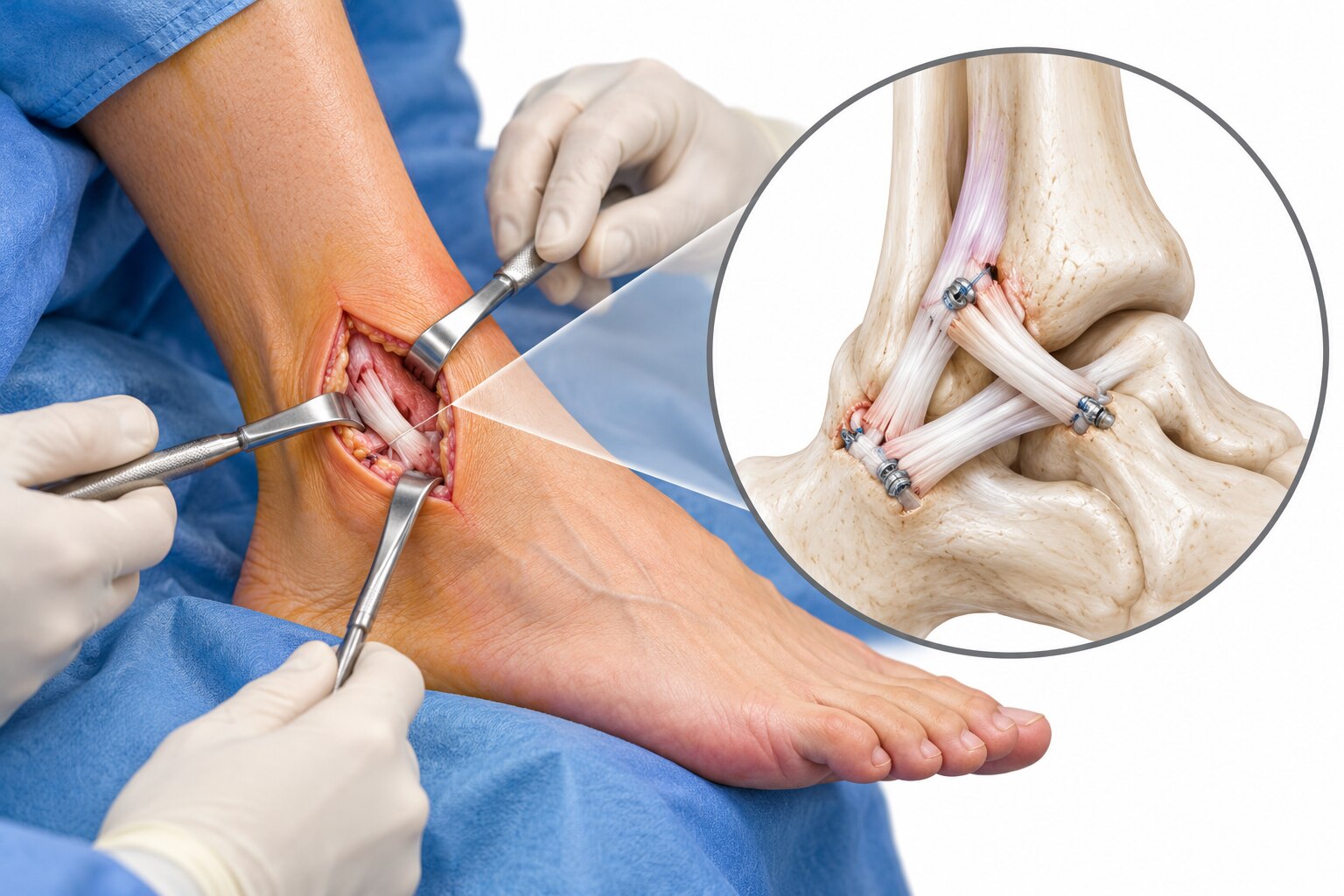
Repair is enough when the native ligament tissue remains strong enough to hold sutures. An anatomic repair, commonly a modified Broström-Gould repair, reattaches and tightens the anterior talofibular ligament and calcaneofibular ligament, often with suture anchors.
Reconstruction replaces the insufficient ligament with a tendon graft. An autograft uses your own tendon; an allograft uses donated tendon tissue. Surgeons consider either when the ligament is poor or attenuated, a previous repair has failed, revision surgery is required, generalized laxity affects several joints, or a selected high-demand athlete needs additional reinforcement.
The answer to “how ankle ligament reconstruction surgery for works in mumbai” depends on these findings, not the city.
Surgery is considered only after persistent giving-way or activity limitation remains despite a properly completed programme that includes:
- Physiotherapy focused on ankle movement and control
- Peroneal strengthening
- Balance and proprioception training
- Bracing during vulnerable activities
- Activity modification and suitable footwear
High-grade tears, cartilage or tendon injuries, impingement, or other associated problems can also support surgery when symptoms persist. An abnormal MRI alone is not enough if examination shows a clinically stable ankle.
For ankle ligament repair in mumbai, ask whether the proposed operation is a native-tissue repair or graft reconstruction, and why that choice fits your tissue quality, previous surgery and activity goals.
What happens during surgery and rehabilitation?
The operation is planned after a medical review, imaging review and anaesthesia assessment. A typical ankle ligament surgery process in Mumbai uses day-care or short-stay admission under regional anaesthesia, general anaesthesia, or both.
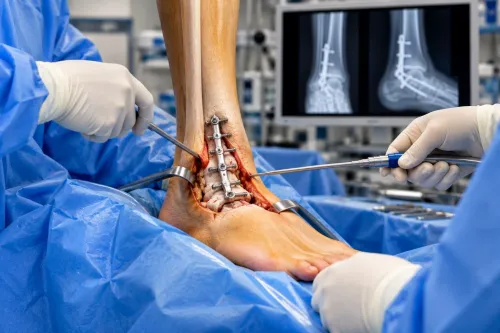
1. The surgeon makes an anatomic repair when the native ligament is strong enough, commonly reattaching the anterior talofibular and calcaneofibular ligaments with suture anchors. If tissue is poor, stretched, or surgery has failed before, a tendon autograft or allograft may reconstruct the ligament.
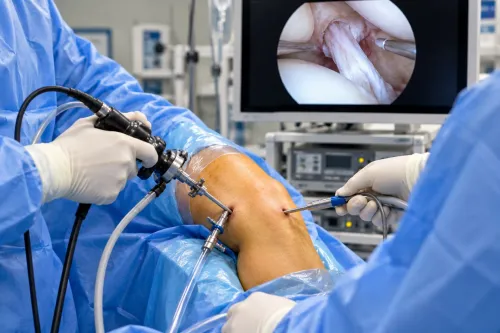
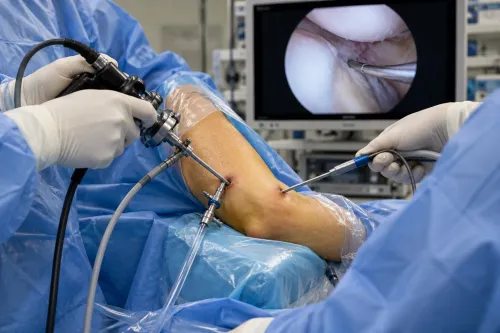
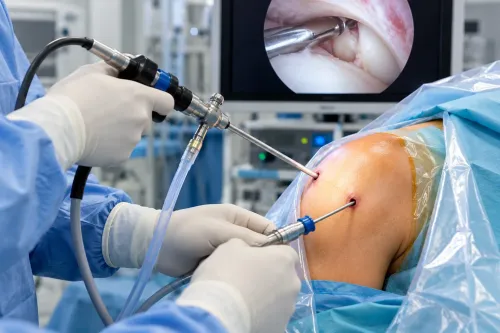
2. Ankle arthroscopy can be added through small portals to remove inflamed synovium, treat anterior impingement or loose bodies, or address an osteochondral lesion of the talus. Arthroscopy does not replace mechanical stabilisation when the ligaments are insufficient.
3. After fixation, the ankle is closed, dressed and placed in a splint or boot. Protected weight-bearing commonly lasts about 2–6 weeks, depending on the repair and the surgeon’s protocol; loading too early can stretch or disrupt the reconstruction.
4. Rehabilitation then restores motion, calf strength, balance, proprioception and sport-specific control. Running and pivoting wait until strength and balance recover, so return to sport often takes about 4–6 months rather than a few weeks.
Discuss recurrent instability, stiffness or lost dorsiflexion, wound problems, infection, superficial peroneal or sural nerve irritation, painful hardware, complex regional pain syndrome and venous thromboembolism before consenting.
How should you compare ankle ligament surgery options in Mumbai?
Compare the indication and recovery plan, not whether a clinic advertises “minimally invasive” surgery. Ankle ligament repair in Mumbai and ankle instability surgery in Mumbai do not follow a city-specific technique.
The choice depends on tissue quality, ankle alignment, associated cartilage or tendon lesions, previous operations and your activity goals. Arthroscopy can treat an osteochondral lesion or impingement, but it does not stabilise an insufficient ligament by itself.
| Option | What it means | When it applies |
|---|---|---|
| Repair | Reattaches and tightens usable native ligament, often with suture anchors | Adequate tissue, commonly an anatomic Broström-Gould repair |
| Graft reconstruction | Replaces or reinforces the ligament with an autograft or allograft | Poor or stretched tissue, revision surgery, generalized laxity or selected high-demand cases |
Take this checklist to your consultation:
- Which ligament is unstable: the ATFL, CFL, syndesmosis or a medial ligament?
- Is the proposed operation a native-tissue repair or graft reconstruction?
- Will arthroscopy be performed, and what additional lesion will it treat?
- Which graft, if any, and which fixation device will be used?
- When can you bear weight, stop the boot, drive, work and resume running?
- Where will postoperative reviews and physiotherapy occur, and who handles urgent swelling, fever, wound drainage or uncontrolled pain after discharge?
Check that the surgeon routinely performs foot-and-ankle or sports-injury reconstruction. Dr. Sujit Korday- Orthopaedic Surgeon can provide assessment, surgical planning and coordinated rehabilitation, so ask how those stages are organised before choosing.
Related service
Ankle ligaments reconstruction or repair Ankle ligaments reconstruction or repair Ankle ligament reconstruction or repair is a surgical procedure performed if the joint still feels unstable after a fracture. View service → |
Frequently asked questions
Which ankle ligaments cause instability, and what symptoms matter?
Lateral ankle instability usually involves the ATFL and CFL. Symptoms include repeated ankle rolling, pain on uneven ground, swelling, tenderness, and a feeling that the ankle may give way. High ankle sprains and deltoid-ligament injuries require a different assessment.
How is chronic ankle instability confirmed before surgery?
The assessment combines your injury history, walking and balance examination, ligament stress tests, and imaging. X-rays check bone alignment and arthritis; MRI assesses ligament damage, cartilage, tendons, and other causes of persistent symptoms.
When is ligament repair enough, and when is reconstruction needed?
Repair is suitable when the existing ligament has enough healthy tissue for the surgeon to reattach and tighten it. Reconstruction is considered when the ligament is severely damaged, stretched, absent, or unsuitable for repair, using a tendon graft for stability.
What happens during ankle ligament surgery and rehabilitation?
The surgeon examines the joint, treats associated damage when necessary, and repairs or reconstructs the unstable ligament through small incisions or an open approach. Rehabilitation progresses from protection and swelling control to weight-bearing, range-of-motion work, strength, balance, and sport-specific training.
How should you compare ankle ligament surgery options in Mumbai?
Ask which ligaments are injured, whether repair or reconstruction is recommended and why, whether arthroscopy is needed, what graft is planned, how complications are handled, and how long each rehabilitation stage lasts. Compare the surgeon’s relevant experience, facility support, follow-up access, and complete treatment costs.
Keywords