Pain with reaching overhead, weakness, clicking, stiffness, or repeated shoulder slipping can come from several different conditions, and an MRI finding alone does not decide whether surgery is appropriate. You will be able to match symptoms and test results to likely causes, understand when non-surgical care comes first, and compare arthroscopy with repair, rehabilitation, injections, open surgery, and replacement.
Key takeaways
- Painful movement can come from the shoulder, neck, or referred nerve pain.
- Get a diagnosis before deciding whether you need shoulder arthroscopy.
- Arthroscopy uses small incisions, a camera, and specialised instruments.
- Plan for sling use, exercises, transport, and follow-up before surgery.
What is causing your painful shoulder movement?
Painful movement does not identify the cause by itself. Shoulder joint problems can include a rotator-cuff tear, Bankart or SLAP labral tear, instability, impingement, bursitis, cartilage damage, loose bodies, frozen shoulder, acromioclavicular-joint disease, or arthritis. Pain from cervical nerve compression or another referred source can feel similar.
- The clinician asks when pain began, whether it followed a fall or dislocation, which movements trigger it, whether you have night pain, weakness, clicking, numbness, or loss of motion, and how symptoms affect work or sport.
- Examination compares active and passive range of motion, rotator-cuff strength, tenderness, painful arcs, neck movement, sensation, and instability signs such as apprehension during specific positions. A stiff shoulder points toward frozen shoulder or arthritis; true weakness after injury raises concern for a cuff tear.
- X-rays show fractures, arthritis, alignment, bone loss, and acromioclavicular-joint changes. Ultrasound can assess tendons dynamically, while MRI shows rotator-cuff and labral tears, cartilage, bursae, and loose bodies.
An MRI tear is not automatically the pain source: labral changes and partial cuff tears can be age-related or incidental. The examination and symptoms must match the scan. If uncertainty remains, an image-guided injection can test whether a joint or bursa is generating pain.
Diagnostic arthroscopy is reserved for unresolved cases where direct inspection could change treatment.
Do you need shoulder arthroscopy or another treatment?
You do not automatically need shoulder arthroscopy because an MRI shows a tear or because movement hurts. The decision depends on the diagnosis, symptom duration, weakness, functional loss, examination, imaging, and response to structured care.
Initial shoulder pain treatment in Mumbai or elsewhere usually includes activity modification, prescribed physiotherapy, suitable analgesic or anti-inflammatory medicine, ice or heat, and selected injections.
- Try the treatment matched to your diagnosis and follow its rehabilitation plan. A cuff tear, frozen shoulder, instability, and arthritis need different programmes; ask for a procedure-specific review rather than an arbitrary promise that you will recover in six weeks.
- Arthroscopy becomes more compelling for a repairable rotator-cuff or labral tear, recurrent traumatic instability, substantial weakness, a loose body, or persistent loss of function despite appropriate care.
- Acromioplasty is not a universal fix for impingement. Shoulder replacement is usually discussed for advanced joint-surface damage with ongoing pain and disability, not every painful shoulder.
- Seek prompt assessment after a dislocation, major weakness following injury, or suspected fracture.
| Option | When it fits | Important limitation |
|---|---|---|
| Physiotherapy alone | Pain or stiffness without urgent structural failure | Progress depends on diagnosis and adherence |
| Injection | Short-term pain control or diagnostic clarification | It does not repair a tear or restore cartilage |
| Arthroscopic repair or decompression | A specific treatable lesion is confirmed | Recovery and healing still take time |
| Open surgery | Bone loss or complex instability | Larger operation and rehabilitation burden |
| Shoulder replacement | Advanced arthritis | Not a routine treatment for isolated impingement |
What happens during a shoulder arthroscopy?
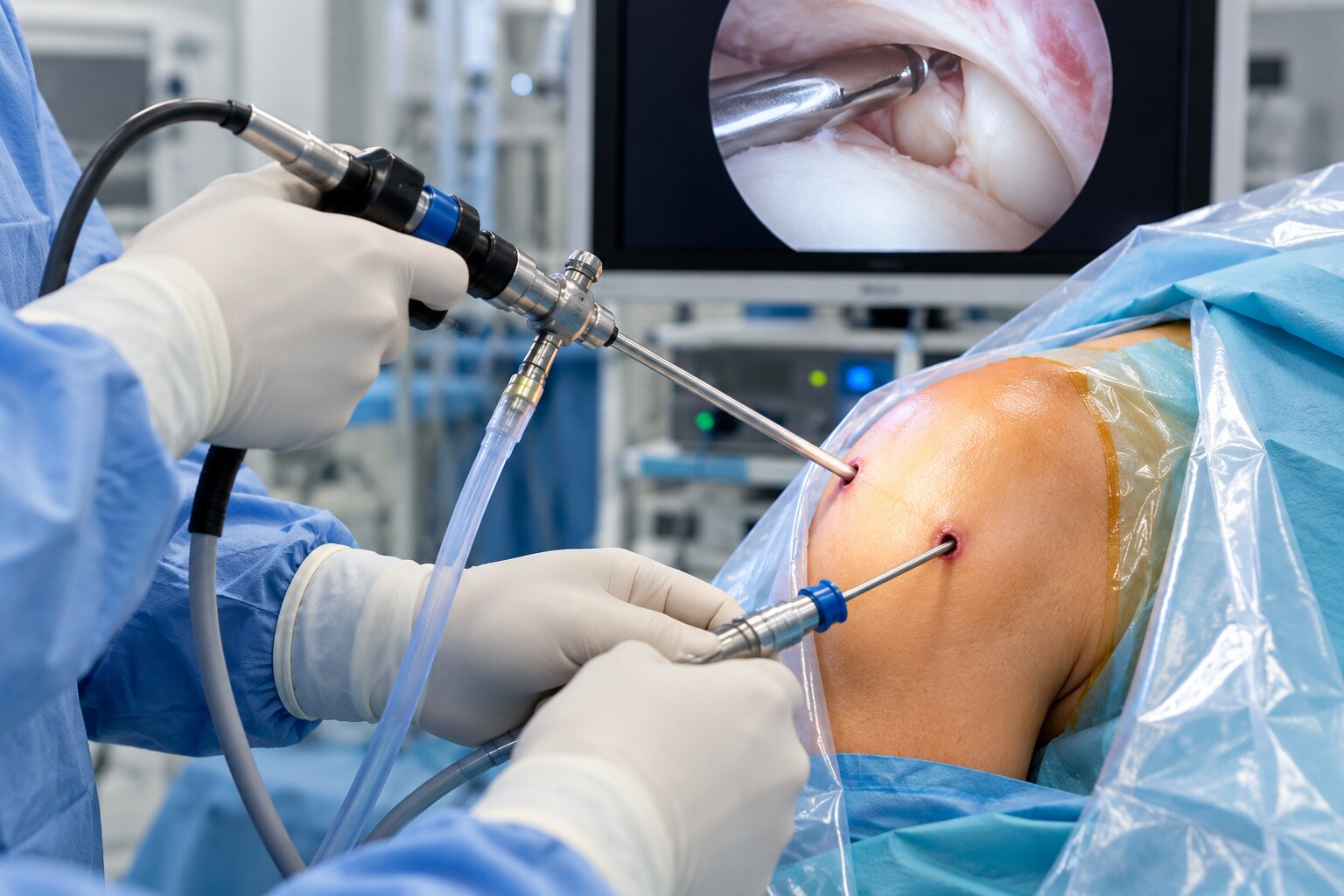
The operation uses anaesthesia, small portal incisions, a camera, and specialised instruments to inspect and treat a defined shoulder problem. You are usually placed in a beach-chair or side-lying position under general anaesthesia, often with a regional nerve block for pain control.
- The surgeon makes small portals around the shoulder and fills the joint with sterile fluid for visibility.
- A camera examines the glenohumeral joint, including the cartilage, labrum, biceps attachment, rotator cuff, and joint lining.
- The camera then assesses the subacromial space, where bursitis, tendon damage, or crowding may be present.
- Instruments through the other portals repair or remove the abnormal tissue. This can include rotator-cuff repair, labral repair or stabilisation with anchors, loose-body removal, treatment of selected bursitis or cartilage problems, and a carefully selected release for persistent frozen shoulder.
Arthroscopy is not always sufficient. Bone loss, complex instability, advanced arthritis, or another finding can require an open procedure; arthroscopy also cannot restore lost cartilage. If you are considering shoulder arthroscopy in mumbai, disclose diabetes, smoking, blood-thinning medicines, allergies, sleep apnoea, previous shoulder operations, and any nearby skin infection.
Ask about infection, bleeding, nerve or blood-vessel injury, blood clots, anaesthetic complications, stiffness, persistent pain, failed healing, and further surgery. The decision should match a specific treatable diagnosis, not an MRI finding alone.
What will recovery require after the operation?
Recovery is usually faster after diagnostic inspection, loose-body removal, or tissue trimming than after a repair, but “minimally invasive” does not mean minor. Repairs need biological healing, protected movement, and months of rehabilitation.
| Procedure | Expected recovery burden | Main limitation |
|---|---|---|
| Diagnostic inspection or tissue removal | Often quicker return to daily activities | Pain, wound care, and temporary movement limits |
| Decompression | Gradual improvement as irritation settles | Soreness with lifting and overhead use |
| Labral repair or stabilisation | Sling protection followed by staged rehabilitation | Early movement and lifting can stress the repair |
| Rotator-cuff repair | The longest protection and strengthening period | The tendon must heal before heavier loading |
Your exact milestones depend on the operation, tear size, tissue quality, and rehabilitation protocol. After a cuff or labral repair, progression usually moves through protection, gentle passive motion, active movement, and strengthening. Heavy lifting too early can damage healing tissue even when pain has improved.
Before leaving, ask for clear instructions about:
- How long to wear the sling and whether you may remove it for exercises
- Which pain medicines to take, at what dose, and what side effects require help
- How to dress the wound and when stitches or dressings come off
- How to sleep, drive, return to work, lift, and begin physiotherapy
- Which exercises are allowed now and which movements are prohibited
Seek urgent medical advice for fever, wound drainage, worsening pain, new numbness or weakness, chest symptoms, or a markedly swollen arm.
How should you choose shoulder arthroscopy in Mumbai?
Choose shoulder arthroscopy for shoulder pain in mumbai only when a specific diagnosis, expected benefit, and recovery plan make sense—not because an MRI shows an abnormality.
Ask the surgeon to answer these questions:
- What is the diagnosis, and which examination findings support it?
- How do those findings match the X-ray, ultrasound, or MRI?
- What happens if I choose physiotherapy, medication, activity changes, or an injection instead?
- What improvement is realistic, and how long will recovery take?
- What rehabilitation protocol applies to this exact procedure?
- Who provides anaesthesia, where will follow-up occur, and who will arrange physiotherapy?
- What is the plan if pain, weakness, or stiffness persists?
| Option | What it involves | When it applies |
|---|---|---|
| Non-operative care | Physiotherapy, medicines, activity changes, or selected injection | Before surgery when function can improve without repair |
| Arthroscopy | Treatment of a defined problem such as a repairable tear, instability, or loose body | When symptoms, examination, imaging, and failed structured care agree |
| Second opinion | Independent review of diagnosis and alternatives | When the recommendation rests only on MRI or the indication is unclear |
Dr. Sujit Korday- Orthopaedic Surgeon is one Mumbai specialist you could consult, but the useful decision remains the diagnosis and safety plan. Ask about infection, nerve injury, anaesthesia complications, failed healing, and further surgery. Seek prompt assessment for dislocation, major injury-related weakness, or suspected fracture.
Related service
Arthroscopic Surgery of Shoulder Arthroscopic Surgery of Shoulder Arthroscopic Surgery of Shoulder View service → |
Frequently asked questions
What can cause painful shoulder movement?
Causes include rotator-cuff tears, Bankart or SLAP labral tears, instability, impingement, bursitis, cartilage damage, loose bodies, frozen shoulder, acromioclavicular-joint disease, and arthritis. Cervical nerve compression can also refer pain to the shoulder.
Do I need shoulder arthroscopy for shoulder pain?
Not always. The decision depends on your diagnosis, examination, imaging, symptom duration, injury pattern, and response to treatments such as activity changes, physiotherapy, medicines, or injections.
What happens during shoulder arthroscopy?
The surgeon makes small incisions, inserts a camera into the joint, examines the damaged structures, and uses specialised instruments to repair or treat the confirmed problem.
What does recovery after shoulder arthroscopy require?
Recovery can require a sling, prescribed pain control, wound care, staged physiotherapy, activity restrictions, and follow-up appointments. The timeline depends on whether the operation involved inspection, debridement, stabilisation, or tendon repair.
How should you choose shoulder arthroscopy in Mumbai?
Choose an orthopaedic surgeon who explains the diagnosis, non-surgical alternatives, proposed procedure, risks, expected restrictions, rehabilitation plan, and follow-up arrangements before you consent.
Keywords