Age alone does not decide whether an older adult is suitable for partial knee replacement. By checking the location of arthritis, ligament stability, knee movement, overall health and expected recovery demands, you can have a more useful discussion about whether partial or total replacement fits your knee.
Key takeaways
- Age alone does not rule out partial knee replacement for seniors.
- Arthritis limited to one knee compartment supports partial replacement candidacy.
- Strong ligaments and useful knee movement are essential for success.
- Total replacement suits arthritis affecting multiple knee compartments.
Does age rule out partial knee replacement for seniors?
Age alone does not rule out partial knee replacement for seniors. An older adult may be a candidate if arthritis is confined mainly to one knee compartment, the major ligaments remain reliable, the knee still moves well, and pain limits walking or daily activities despite appropriate non-surgical treatment.
The question in partial knee replacement for older adults in Mumbai is not simply how many birthdays you have had.
A surgeon assesses:
- Arthritis limited to one compartment, rather than disease throughout the knee.
- A functioning anterior cruciate ligament and stable collateral ligaments.
- Acceptable alignment without a severe, fixed deformity.
- Sufficient bending and straightening for the implant to work properly.
- Medical fitness, including frailty, heart or lung disease, diabetes control, kidney disease, anticoagulant use, cognition and home support.
- Willingness to follow physiotherapy and accept a greater chance of later revision than with total knee replacement.
Inflammatory arthritis such as rheumatoid arthritis, widespread cartilage damage, major instability, severe stiffness or pain coming from another part of the knee can make partial replacement the wrong operation. A smaller incision does not fix unsuitable anatomy.
Before surgery, discuss weight management where relevant, strengthening and range-of-motion exercises, walking aids, pain medicines and selected injections. Surgery becomes reasonable when these measures have been properly tried but pain and loss of function remain unacceptable.
Standing weight-bearing X-rays usually establish the pattern; long-leg alignment views and MRI are added when examination or imaging leaves ligament status or the diagnosis uncertain.
Which arthritis patterns qualify—and which rule it out?
A partial replacement fits when arthritis is concentrated in one compartment, usually the inner (medial) side, while the rest of the knee and its stabilising ligaments remain usable. For someone researching partial knee replacement arthritis in mumbai, the key issue is anatomy—not age alone.
| Feature | Supports partial replacement | Makes it unsuitable |
|---|---|---|
| Damaged area | Wear confined mainly to one compartment, with pain matching that area | Substantial arthritis in the outer (lateral), kneecap (patellofemoral), or multiple compartments |
| Ligaments | Stable collateral ligaments and a functioning anterior cruciate ligament (ACL) | Major ACL or other ligament deficiency causing giving-way or abnormal motion |
| Alignment | Mild deformity that the surgeon can correct and balance | Severe fixed bow-legged or knock-kneed deformity |
| Movement | Nearly full straightening and useful bending | Marked stiffness, especially inability to fully straighten the knee |
| Disease pattern | Localised osteoarthritis after non-surgical treatment fails | Rheumatoid arthritis or another inflammatory disease affecting the knee broadly |
The examination tests whether pain is localised, the knee is stable, and the deformity corrects when the leg is positioned. Standing, weight-bearing knee X-rays show joint-space loss under load; a long-leg alignment view measures the hip-to-ankle axis when deformity needs closer assessment.
MRI is not automatically required. Use it when X-rays and examination do not establish the diagnosis, or when the ACL, cartilage in another compartment, or an unexpected pain source remains uncertain. A robotic system can improve planning precision, but it cannot overcome arthritis in several compartments or an unstable knee.
How does partial replacement compare with total replacement?
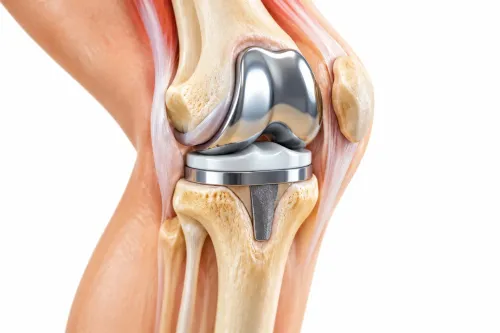
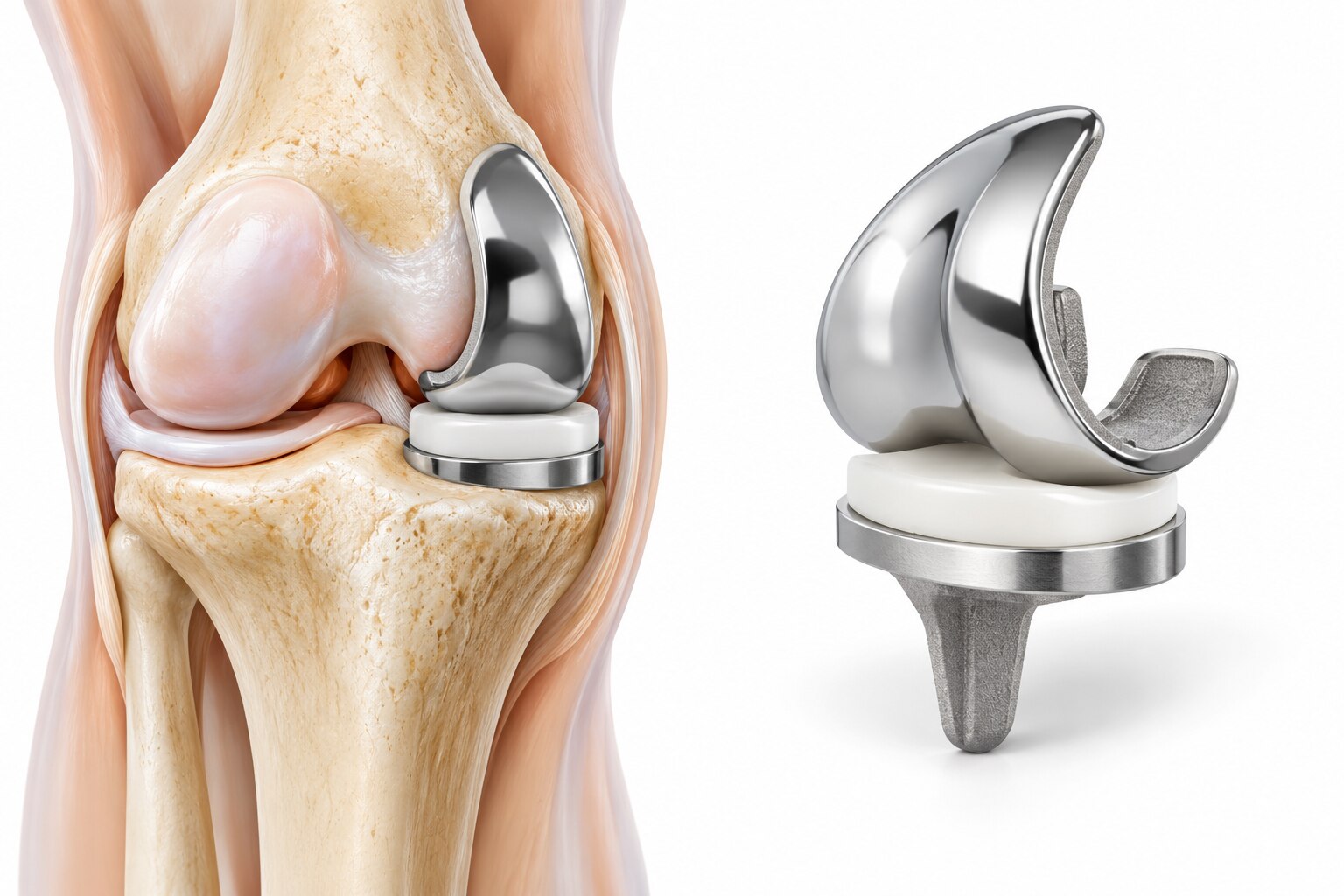
Partial knee replacement preserves more bone, cartilage and functioning ligaments than total knee replacement. It is a joint preserving knee surgery for arthritis confined to one compartment, not a smaller version of the total operation.
| Option | Partial knee replacement | Total knee replacement |
|---|---|---|
| Bone and ligaments | Removes less bone and retains suitable native ligaments, including the ACL | Replaces damaged joint surfaces across the knee and sacrifices more bone |
| Movement | Often feels more like a natural knee when selection and ligament balance are right | Reliable pain relief, but movement can feel less natural |
| Early recovery | Usually less blood loss and faster early functional recovery | Recovery is often longer because more of the knee is resurfaced |
| Risks | Narrower indication; arthritis progression, bearing dislocation, loosening or persistent pain can require revision | Broader indication; infection, stiffness, loosening and other complications remain possible |
| Later surgery | Conversion to total replacement is feasible, but it is revision-type surgery, not a simple upgrade | Later revision can involve bone loss and revision implants if the components fail |
A minimally invasive knee replacement approach may reduce tissue disruption, but a small incision does not guarantee better long-term results. Accurate component positioning and ligament balancing matter more than incision size; forcing that approach in a difficult knee can compromise the result.
Partial replacement also carries a higher chance of later revision than total replacement in many comparisons. Conversion becomes more complex when there is bone loss, loosening, infection, stiffness or damaged ligaments; revision components or bone grafting may then be necessary.
What recovery demands should an older adult expect?
Expect discharge with a walker or crutches, a wound-care plan, pain medicines, and exercises to begin at home. Some patients leave quickly; others stay longer for medical monitoring, pain control, or safer transfers. Arrange an adult to help with meals, bathing, medicines, and transport, especially if you have frailty, poor balance, or limited home support.
During the first days, physiotherapy focuses on safe weight-bearing, knee straightening, bending, ankle movements, and strengthening the thigh. Your therapist will teach you:
- How to stand, sit, and walk with the prescribed aid
- How to use stairs, usually one step at a time while holding a rail
- Which exercises to repeat, and when to increase walking distance
- How to spot concerning wound drainage, fever, calf swelling, or uncontrolled pain
Do not drive until you can enter and exit safely, control the vehicle, perform an emergency stop, and take no medicine that impairs alertness; your surgeon and insurer’s requirements also matter. Begin with light household tasks at waist height, avoiding lifting, kneeling, twisting, and prolonged standing.
Partial knee replacement for seniors still demands regular rehabilitation, even when walking improves quickly. Confidence often returns in stages: first indoors, then outdoors on level ground, followed by uneven surfaces and longer distances. A walking aid is support, not failure.
How should you choose and evaluate treatment in Mumbai?
A sound Mumbai consultation should end with a clear reason for choosing partial, total, or non-surgical treatment—not simply a recommendation based on age. If you searched partial knee replacement arthritis in mumbai, take these questions to the appointment:
- Which standing, weight-bearing X-rays confirm that arthritis is confined to one compartment? Do I need a long-leg alignment view or MRI?
- How many unicompartmental replacements do you perform each year, and what is your conversion rate to total knee replacement?
- Which implant system and bearing design do you use, and why do they suit my bone quality, alignment and activity?
- Will robotic or computer-assisted planning improve accuracy in my case, or is it only a marketing label?
- If this implant loosens or fails, what could make conversion to total replacement complex—bone loss, infection, stiffness or ligament damage?
- What follow-up schedule, X-rays and physiotherapy access will I have in Mumbai?
- What non-surgical options remain reasonable, and what specific change would make surgery worthwhile?
| Option | What it means | When it applies |
|---|---|---|
| Non-surgical care | Exercise therapy, weight management, medication or injections | Pain remains manageable and function is acceptable |
| Partial replacement | Preserves the unaffected compartments and more bone | One compartment is damaged, ligaments work and movement is preserved |
| Total replacement | Replaces all knee compartments | Arthritis is widespread, deformity is fixed or the knee is unstable |
Dr. Sujit Korday- Orthopaedic Surgeon should be asked to explain the imaging and failure plan in writing, not only the operation name. Joint preserving knee surgery is valuable only when the diagnosis supports it; robotic assistance cannot correct arthritis in multiple compartments.
Related services
Partial Knee Replacement (also known as unicompartmental knee replacement) is a surgical procedure that replaces only the damaged part of the knee joint, rather than the... View service → |
Total Knee Replacement (TKR) — also called Total Knee Arthroplasty — is a surgical procedure in which the entire knee joint is replaced with artificial components... View service → |
Frequently asked questions
Does age rule out partial knee replacement for seniors?
No. Candidacy depends on arthritis location, ligament reliability, knee movement, pain severity, and overall health rather than age alone.
Which arthritis patterns qualify for partial knee replacement?
Partial replacement suits arthritis mainly confined to one knee compartment when the major ligaments remain reliable and the knee still moves well.
Which arthritis patterns rule out partial knee replacement?
Arthritis affecting multiple compartments, unreliable major ligaments, or severe stiffness can make total knee replacement more suitable.
How does partial replacement compare with total replacement?
Partial replacement preserves more of the natural knee and treats one damaged compartment. Total replacement treats arthritis across the knee when disease is more widespread.
What recovery demands should an older adult expect?
Recovery requires wound care, pain control, walking practice, exercises, and follow-up. Your surgeon will set activity and rehabilitation milestones based on your health and procedure.
Related service
Knee Surgery refers to a variety of surgical procedures performed to treat injuries, arthritis, deformities, and other conditions affecting the knee joint. View service → |
Keywords